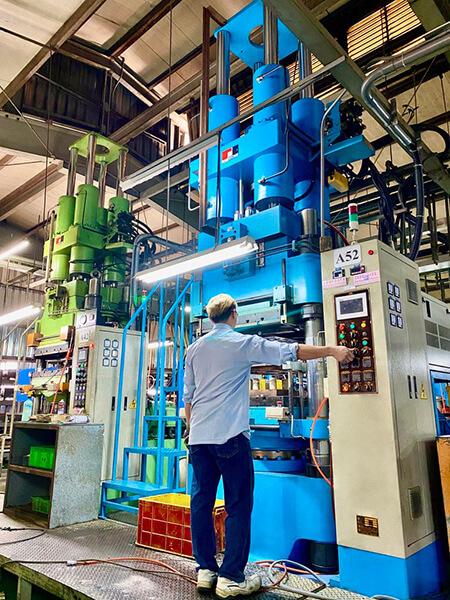
Vacuum injection vulcanization molding is an advanced rubber manufacturing technology that combines the high-speed efficiency of injection molding with vacuum assistance to produce premium, defect-free rubber parts.
Unlike standard molding processes, this method creates a vacuum environment inside the mold cavity right before the injection phase. This eliminates trapped air and air resistance, allowing the rubber to flow flawlessly. It is specifically designed for the mass production of highly complex parts, offering fast cycle times and extreme dimensional precision.
How Does the Vacuum Injection Vulcanization Process Work?
To understand why this technology is so effective for intricate designs, here is a breakdown of the core manufacturing steps:
1. Material Preparation
The process begins with formulating an uncured rubber compound tailored to the final product's specific performance requirements. These custom mixtures typically include a rubber base, fillers, curing agents, and other additives for environmental or chemical resistance.
2. Vacuuming the Mold Cavity
Before the rubber material is injected, the mold is closed, and a high-performance vacuum system extracts all the air. This is a critical step for complex parts. By removing the air, the system prevents bubbles, voids, and "short shots" (incomplete filling) that often occur in standard injection processes when air gets trapped in tiny mold crevices.
3. High-Pressure Injection
Once the vacuum is established, the pre-heated, flowable rubber mixture is injected rapidly into the mold cavities under high pressure. Because there is no air resistance in the vacuum state, the material effortlessly reaches every microscopic corner of the mold, capturing the most intricate geometric details.
4. Vulcanization (Curing)
After injection, the material remains inside the heated mold under pressure. This initiates the vulcanization process—the chemical reaction where the rubber molecules cross-link. This crucial step transforms the soft, sticky raw material into a durable, highly elastic, and heat-resistant final product. The vacuum ensures uniform heat transfer, resulting in perfectly consistent material density.
5. Demolding
Once the vulcanization cycle is complete and the rubber has fully cured, the mold opens, and the highly precise final part is removed for inspection.
Key Advantages for High-Volume Production
Vacuum injection molding offers significant technical and commercial benefits when scaling up production:
- Ideal for Complex Geometries: High-pressure injection forces the material into intricate mold designs with extremely tight tolerances, making it possible to produce shapes that are impossible with standard methods.
- Fast Cycle Times: The highly automated nature of injection molding, combined with rapid material heating, translates to shorter curing times and exceptional output efficiency.
- Zero-Defect Goal: Eliminating trapped air drastically reduces internal voids, ensuring reliable sealing performance and mechanical stability.
- High Material Utilization: Precise control over the injection volume minimizes rubber waste, leading to better cost-efficiency over large production runs.
Industries and Applications
Because of its rapid production capabilities and precise detailing, rubber vacuum injection molding is the go-to choice for demanding applications:
- Automotive: Complex wire harness seals, precision O-rings, and custom engine gaskets.
- Medical Devices: Micro-seals and high-purity silicone components requiring zero surface imperfections.
- Electronics: Waterproof grommets, tiny shock-absorbing pads, and intricate environmental seals.
Vacuum Injection vs. Vacuum Compression Molding
While vacuum injection molding is the superior choice for high-volume production and highly complex, intricate parts, it does require higher initial tooling and equipment investments.
Need a solution for larger parts or lower production volumes?
If your project involves large-scale rubber components, medium-to-low production runs, or strict budget constraints on mold tooling, Vacuum Compression Molding might be a more cost-effective alternative. To learn more about this approach, read our guide on What Is Vacuum Compression Molding for Rubber Parts.
Partner with Zong Yih Rubber for Custom Molding Solutions
Choosing the right manufacturing process depends entirely on your part design, application, and production volume. At Zong Yih Rubber, we possess deep expertise in both injection and compression molding. Our engineering team works closely with OEM and industrial clients to evaluate structural requirements and recommend the most cost-effective, high-quality production technology.
Need High-Precision Rubber Parts for Your Next Project? Contact us today to request a quote or schedule an engineering consultation.